
CASE STUDY

 Although corrosion is usually a predictable and manageable phenomenon, it is now evident that certain conditions in the marine environment lead to corrosion rates far in excess of normal. Left unchecked, this can ultimately lead to primary and secondary structural deterioration, significant costs and increased safety risks. A typical corrosion rate for steel in a marine environment could be regarded as 0.1mm to 0.5mm per year. However, in cases of accelerated corrosion, rates of 1mm per year or even higher have been reported, clearly anything that will eat through a 5mm plate in 5 years has to be taken seriously.
Although commonly referred to as Accelerated Low Water Corrosion, ALWC can occur in
areas away from the low water band and be caused by different individual or combinations of corrosion mechanism and may also be referred to simply as Accelerated or Concentrated Corrosion as well as Microbially influenced Corrosion (MIC).
The first signs of accelerated corrosion on a marine structure may also be the last. Once the surface behind a quay has subsided, for
example, and hundreds of cubic metres of backfill have been deposited through large holes
in the quay wall, the resulting structural instability and reduced navigable depth of the quayside would mean total reconstruction of the quay or
even total shutdown.
Although corrosion is usually a predictable and manageable phenomenon, it is now evident that certain conditions in the marine environment lead to corrosion rates far in excess of normal. Left unchecked, this can ultimately lead to primary and secondary structural deterioration, significant costs and increased safety risks. A typical corrosion rate for steel in a marine environment could be regarded as 0.1mm to 0.5mm per year. However, in cases of accelerated corrosion, rates of 1mm per year or even higher have been reported, clearly anything that will eat through a 5mm plate in 5 years has to be taken seriously.
Although commonly referred to as Accelerated Low Water Corrosion, ALWC can occur in
areas away from the low water band and be caused by different individual or combinations of corrosion mechanism and may also be referred to simply as Accelerated or Concentrated Corrosion as well as Microbially influenced Corrosion (MIC).
The first signs of accelerated corrosion on a marine structure may also be the last. Once the surface behind a quay has subsided, for
example, and hundreds of cubic metres of backfill have been deposited through large holes
in the quay wall, the resulting structural instability and reduced navigable depth of the quayside would mean total reconstruction of the quay or
even total shutdown. 
It is clear that the sooner ALWC is detected and addressed the less expensive will be the remedial options. Early intervention makes economic sense.
The main obstacle to detecting accelerated corrosion, however, is the fact that most incidents occur at or below the low-water line and are therefore not readily seen. Furthermore the telltale signs, be they above or below the water line, can be covered and visually hidden by years of accumulation of marine growth.
As a first stage in managing this problem the following has to be addressed:
The second stage, which we will come to later, deals with both prevention and cure of ALWC.
The main obstacle to detecting accelerated corrosion, however, is the fact that most incidents occur at or below the low-water line and are therefore not readily seen. Furthermore the telltale signs, be they above or below the water line, can be covered and visually hidden by years of accumulation of marine growth.
As a first stage in managing this problem the following has to be addressed:
- What are the corrosion mechanisms?
- What is the significance of accelerated corrosion attack?
- What does accelerated corrosion look like?
- How can it be detected, preferably in the early stages?
The second stage, which we will come to later, deals with both prevention and cure of ALWC.
CORROSION MECHANISMS
MIC
Microbially Induced Corrosion is that in which the actions of micro-organisms generate conditions that start corrosion. 10% of all corrosion cases involve MIC and the majority of accelerated low water corrosion cases are caused by the action of the sulphate-reducing bacteria (SRB) organism in particular.Normally, structural steel, in the absence of crevices or galvanic effects, tends to corrode over its entire surface. The rate of corrosion is controlled by the rate at which dissolved oxygen reaches the metal surface. Biological organisms have the potential to increase or decrease oxygen transport to the surface; consequently increasing or decreasing general corrosion. Most MIC, however, manifests as localised corrosion because microscopic organisms tend to settle on metal surfaces in the form of discrete colonies rather than continuous films.
Biological organisms fall under two groups based on the type of corrosion they cause: Anaerobic corrosion and aerobic corrosion. Sulphate reducing bacteria (SRB) are anaerobic, they form corrosive sulphide by reducing sulphate. SRBs consume hydrogen and “depolarise” the cathode, thereby accelerating corrosion. Aerobic sulphur oxidizing bacteria can create an environment of up to 10 percent sulphuric acid, thereby encouraging rapid corrosion.
Colonies of bacteria produce sticky polymers which attract other species to colonisation sites. This, in addition to the metabolism of available oxygen, iron, manganese, etc., leads to the formation of crevices as well as oxygen and ion concentration cells, accelerating the corrosion process. Because most bacteria remain fixed to the colonisation site, they create a condition underneath which causes the anodic site to become fixed, leading to pitting. This is why more than 90% of MIC is seen as pitting-type corrosion.
Microbes also produce short-chain fatty acids (acetic acid being the most common) that are very aggressive, especially to carbon steel, when concentrated under a colony or other deposit.
Other mechanisms influencing ALWC may include:
- Microcellular corrosion: where electric cells set up between different areas of metal on the structure, usually steel, causing one area not to corrode at the expense of increased corrosion at the other.
- Stray current: similar to micro-cellular but corrosion is induced by the presence of some electrical installation in the vicinity e.g. an electric travelling dockside crane.
- Erosion: although strictly not a corrosion mechanism the periodic dynamic removal of corrosion surface deposits, by vessel rubbing, propeller wash, tidal or other currents, can increase the corrosion rate due to faster regeneration of deposits.
THE SIGNIFICANCE OF THE ATTACK
Accelerated corrosion is usually associated with sheet-pile walls (accelerated low water corrosion), particularly at a level at or just below static (non-tidal) or low water level in tidal areas. However, there are instances of it occurring on hollow section and H-piles down to bed level, and on any other unprotected steel components in a susceptible location.
Example: Northern Territory Department of Transport and Works Report, 13.09.1998
An engineering report, investigating the collapse of a Northern Territory bridge, found that two piles of the Adelaide River Bridge were completely corroded through the base. This was caused by a
number of factors, including a sulphate reducing bacteria which had attacked the steel and which had not previously been known to exist in tropical conditions.
Sinclair Knight Merz, commissioned to investigate the collapse, reported five contributing causes for the corrosion of steel piles.
- Sulphate Reducing Bacteria: Extensive colonies with mushroom-like heads were found on the piles, particularly on bare steel sections. The bacteria produced a sulphide slime, which attacked the steel and resulted in large pit corrosion.
- Sulphide Mud: A significant removal of mud from the bridge site had occurred over 30 years, exposing sulphides. Oxidation then produced a weak sulphuric acid, which attacked the piles.
- Abrasion: Water velocity reaching 3.5 metres per second continuously removed corrosion as it formed.
- Galvanic action within piles: Friction between weld metal and parent metal.
- Galvanic action between pile groups: Corrosion in electrolyte where coatings have degraded from steel.
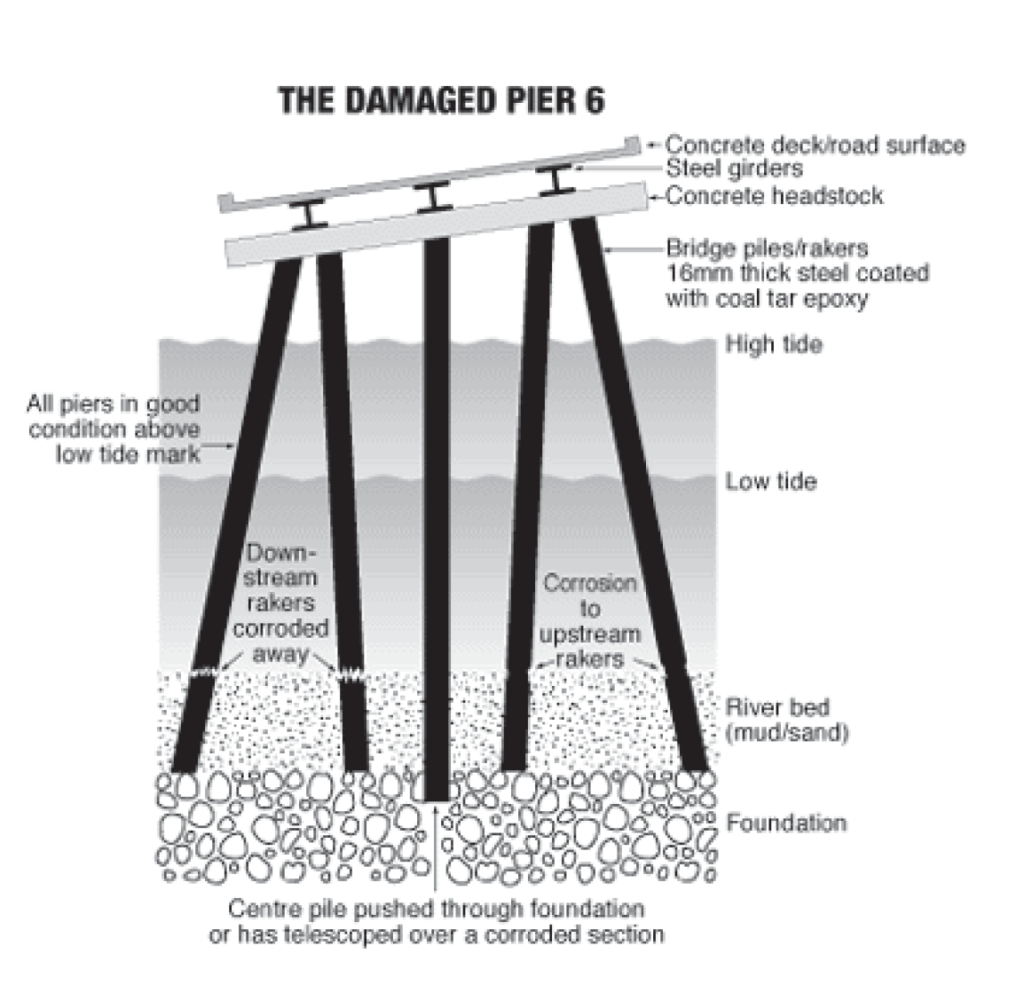
The Adelaide River Bridge was constructed in 1966/67 as a one-lane bridge, although all the sub-structure to support two lanes was designed and built at the same time. The bridge was upgraded to two lanes in 1972/73. The bridge consists of a super structure of a concrete deck sitting atop three steel beams. These beams in turn sit on nine piers spaced at intervals of about 18.3m across the river. Each pier contains five piles, a straight pile in the centre with two “raker” piles on each side. These piles consist of 16mm thick octagonal steel, some filled with concrete to varying levels as demanded in the plans. They are coated with coal tar epoxy.
Regular maintenance included inspection and painting of the piles above the low tide mark, where any corrosion was expected to occur, due to contact with oxygen and salt water. Gradual erosion of the piers below the water line was accounted for in the bridge design. The expected loss in a tropical corrosive atmosphere was 8mm per 100 years, providing a lifespan of over 100 years for the bridge. The fact that the life of the affected piles was reduced by 75% may not be entirely attributable to the Sulphate Reducing Bacteria, but it was clearly a significant factor. It is ironic that the inspection regime took into account the effects of corrosion but had expected the majority to occur above the water line.Steel piles are designed to hold things up, hold things back, or do both. The ability of each pile to do this is directly related to the thickness of steel and its shape. Any reduction of thickness results in a loss of strength. If enough steel is lost at any particular location, say 50%; the ability of the affected pile to work as designed becomes critical. The practical outcome of this could involve placing restrictions on use. If more steel is lost the outcome could be structural failure and complete loss of the facility.
Regular maintenance included inspection and painting of the piles above the low tide mark, where any corrosion was expected to occur, due to contact with oxygen and salt water. Gradual erosion of the piers below the water line was accounted for in the bridge design. The expected loss in a tropical corrosive atmosphere was 8mm per 100 years, providing a lifespan of over 100 years for the bridge. The fact that the life of the affected piles was reduced by 75% may not be entirely attributable to the Sulphate Reducing Bacteria, but it was clearly a significant factor. It is ironic that the inspection regime took into account the effects of corrosion but had expected the majority to occur above the water line.Steel piles are designed to hold things up, hold things back, or do both. The ability of each pile to do this is directly related to the thickness of steel and its shape. Any reduction of thickness results in a loss of strength. If enough steel is lost at any particular location, say 50%; the ability of the affected pile to work as designed becomes critical. The practical outcome of this could involve placing restrictions on use. If more steel is lost the outcome could be structural failure and complete loss of the facility.
APPEARANCE OF ACCELERATED CORROSION
Accelerated Corrosion can take on different appearances, which can be characterised as follows:
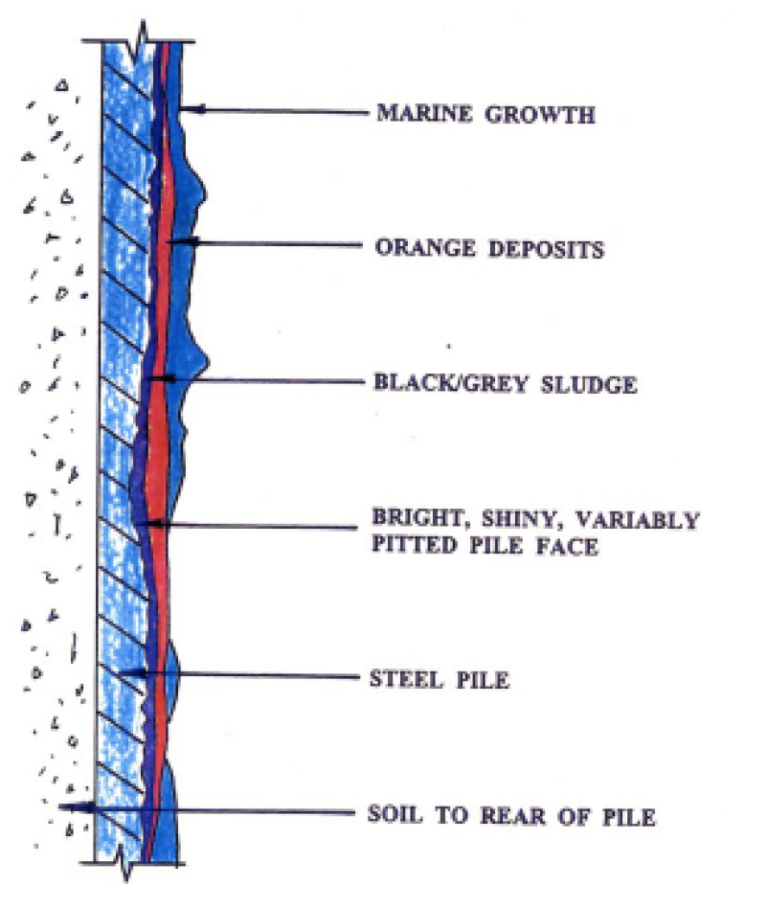
Bright orange areas appear on the steel surface which when disturbed reveal a black/grey sludge underneath in turn overlying a shiny and a locally pitted or eroded steel surface. This can occur on pre-painted piles after only 5 years.
Early stage characteristics can be disguised by an accumulation of marine growth over top. Scraping soon reveals the above appearance with the release of a sulphurous odour and specific areas of dishing or thinning of the steel can be observed.
Accelerated corrosion can exist in quite an advanced state of perforation of the steel, or even as larger holes but, as above, can remain disguised due to overlying marine growth. Even if removal and cleaning does not reveal perforations a good hit with a hand-pick may go right through the apparently sound steel surface (although deliberate perforation is not recommended as even the smallest holes can complicate the repair process later on).
It is usually possible to spot early stage corrosion from a distance but the more advanced stages require closer inspection to become apparent. Occasionally it is the result of accelerated corrosion that is first to be noticed, usually when the ground surface behind a quay wall starts subsiding due to loss of soil through hidden corrosion holes, or on the first occasion that large holes in piles suddenly become manifestly clear.
Early Stage
Bright orange areas appear on the steel surface which when disturbed reveal a black/grey sludge underneath in turn overlying a shiny and a locally pitted or eroded steel surface. This can occur on pre-painted piles after only 5 years.
Middle Stage
Early stage characteristics can be disguised by an accumulation of marine growth over top. Scraping soon reveals the above appearance with the release of a sulphurous odour and specific areas of dishing or thinning of the steel can be observed.
Advanced Stage
Accelerated corrosion can exist in quite an advanced state of perforation of the steel, or even as larger holes but, as above, can remain disguised due to overlying marine growth. Even if removal and cleaning does not reveal perforations a good hit with a hand-pick may go right through the apparently sound steel surface (although deliberate perforation is not recommended as even the smallest holes can complicate the repair process later on).
It is usually possible to spot early stage corrosion from a distance but the more advanced stages require closer inspection to become apparent. Occasionally it is the result of accelerated corrosion that is first to be noticed, usually when the ground surface behind a quay wall starts subsiding due to loss of soil through hidden corrosion holes, or on the first occasion that large holes in piles suddenly become manifestly clear.
DETECTING THE PROBLEM
For early intervention it is therefore essential to look for the problem. Despite the fact that many harbours may have miles of steel piled marine structures, surveying for accelerated corrosion need not be expensive.
The aim of such a survey would be:
The aim of such a survey would be:
- Identify any risk of MIC
- Identify if there is a presence.
- If present, identify the extent.
- If the extent suggests the necessity of remedial works, evaluate the structure.
WHAT TO DO ABOUT ALWC
If a problem exists, or conditions exist that make accelerated corrosion likely to occur, then what
remedial action can be taken, or needs to be taken. Many operators, in the past, have taken a
short-term view, choosing a regime of minimum intervention, passing maintenance costs on to
those who, when the structure fails, have to repair or replace it. Apart from the waste of limited
resources, safety risks and poor appearance that such an approach entails, the economic argument
itself is basically flawed. Repair and replacement has produced far higher cost levels than expected
and part of the reason for this has been the much shorter lifespans caused by accelerated
corrosion.Marine structures of all kinds, steel and concrete, are affected by ALWC. With steel, the
results are more obvious but similar effects are found on concrete structures, where MIC can break
down the surface exposing the reinforcing steel and causing rapid deterioration.
In new construction it is possible to reduce the threat from MIC and ALWC by careful design,
another subject entirely, but in remedial work the most successful way to preventing MIC and
ALWC in both steel and concrete is to coat the threatened structure, isolating vulnerable areas
from their environment.
The use of biocides can be effective in eliminating bacteria but the potential effects on the environment of such products may make them unsuitable. On steel, cathodic protection should protect uncoated structures but, although microbial densities have been shown to be affected, the calcareous films associated with cathodic protection have also shown evidence of microbial activity. In any case, such protection is ineffective in areas that are out of the water, splash zones and the upper half of the tidal zone. By introducing an impervious barrier between the substrate and its environment, the development of suitable conditions for oxidisation can be prevented. If the structure is in a marine or port environment, there may be several reasons why successful coating might be difficult to achieve. Salt water, oil pollution and other forms of contamination affect the bond strength of coatings above the low water level, and for elements that remain submerged, underwater coating may be the only option. If a satisfactory bond can be achieved under all these conditions by a coating which is not, itself, susceptible to the effects of microbial activity, then success is at hand. Environmentally friendly Alocit coating products are particularly suited to this kind of project, both because of their longevity (applications lasting up to 30 years) and because of their unique ability to be applied in splash zones and deep underwater. Adhering strongly on to oily and contaminated concrete or steel, they provide an ideal barrier against ALWC and MIC, research showing that marine structures in vulnerable environments and areas previously affected by similar problems, remain protected for the lifetime of the structure when subject to proper maintenance programmes. Modern requirements for environmentally safe coating products mean that products, like the coal-tar epoxy used on the Australian bridge cited above, which contain potentially harmful chemicals have to be avoided, both because of the containment and disposal costs when re-coating is required and the harm they may cause to the planet’s ecosystem as they wear and leach into surrounding waters.
Best results are achieved against ALWC if sensible precautions are taken from the very beginning. On projects where a new installation is planned components should be pre-coated before installation and checks, complete with necessary touch-ups, should be made after construction is complete. In a project for English Heritage on Lundy Island in the UK, for example, piles were manufactured and coated in Holland, transported by sea to the site, installed, checked and repairs made to coating areas damaged in the construction process. Such an installation should remain maintenance free for many years, although periodic checks for accidental damage are a wise precaution.
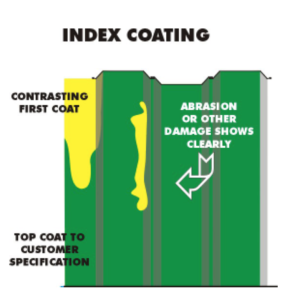
To facilitate maintenance programmes Alocit recommends using a colour index system when coating. By using contrasting colours for the first coat (at least two coats are always required to minimise the possibility of pin-holes), wear in the top coat can be detected before coating integrity is lost. Using this system also helps engineers and contractors follow the correct coating sequence, critical to the long-term success of protective coating systems.
The company’s coatings have a long history of use in aggressive and nutrient-rich environments where microbial attack might be expected. Coatings applied more than thirty years ago in European sewage plants are still intact, retaining full adhesion and protection characteristics. In New York harbour, one of the busiest in the world, a programme that has been in place for years has ensured the long-term survival of its sheet piles by coating vulnerable areas. The Malaysian Navy at its main base has undertaken major refurbishment works to restore corrosion-damaged infrastructure with a coating programme to prevent such deterioration occurring in the future. Wharves and sheet piles on docks and naval facilities in the U.S., Panama, Europe and the Asia Pacific have been repaired and re-coated using Alocit products, both with and without cathodic protection, yet there has been no evidence of any MIC or ALWC induced failures.
A growing awareness of the need to take action in areas that might previously have been considered non-risk areas has lead to a certain amount of press speculation about ‘metal munching microbes’ but, despite the seriousness of the problem, cost-effective remedies are available, as we have shown over the years. In Asia this new awareness has focused attention on preventative measures. Statistics show increased rates of corrosion, and concrete deterioration up to five times faster in tropical regions, with microbial action high on the list of potential causes where water conditions favour bacterial growth. Companies and port authorities that are serious in their approach to corrosion prevention are making sure that all vulnerable areas are coated, in Taiwan for example, a recent harbour development had 40,000 square metres of steel and concrete piles coated with Alocit products, most of it underwater.
The use of biocides can be effective in eliminating bacteria but the potential effects on the environment of such products may make them unsuitable. On steel, cathodic protection should protect uncoated structures but, although microbial densities have been shown to be affected, the calcareous films associated with cathodic protection have also shown evidence of microbial activity. In any case, such protection is ineffective in areas that are out of the water, splash zones and the upper half of the tidal zone. By introducing an impervious barrier between the substrate and its environment, the development of suitable conditions for oxidisation can be prevented. If the structure is in a marine or port environment, there may be several reasons why successful coating might be difficult to achieve. Salt water, oil pollution and other forms of contamination affect the bond strength of coatings above the low water level, and for elements that remain submerged, underwater coating may be the only option. If a satisfactory bond can be achieved under all these conditions by a coating which is not, itself, susceptible to the effects of microbial activity, then success is at hand. Environmentally friendly Alocit coating products are particularly suited to this kind of project, both because of their longevity (applications lasting up to 30 years) and because of their unique ability to be applied in splash zones and deep underwater. Adhering strongly on to oily and contaminated concrete or steel, they provide an ideal barrier against ALWC and MIC, research showing that marine structures in vulnerable environments and areas previously affected by similar problems, remain protected for the lifetime of the structure when subject to proper maintenance programmes. Modern requirements for environmentally safe coating products mean that products, like the coal-tar epoxy used on the Australian bridge cited above, which contain potentially harmful chemicals have to be avoided, both because of the containment and disposal costs when re-coating is required and the harm they may cause to the planet’s ecosystem as they wear and leach into surrounding waters.
Best results are achieved against ALWC if sensible precautions are taken from the very beginning. On projects where a new installation is planned components should be pre-coated before installation and checks, complete with necessary touch-ups, should be made after construction is complete. In a project for English Heritage on Lundy Island in the UK, for example, piles were manufactured and coated in Holland, transported by sea to the site, installed, checked and repairs made to coating areas damaged in the construction process. Such an installation should remain maintenance free for many years, although periodic checks for accidental damage are a wise precaution.
To facilitate maintenance programmes Alocit recommends using a colour index system when coating. By using contrasting colours for the first coat (at least two coats are always required to minimise the possibility of pin-holes), wear in the top coat can be detected before coating integrity is lost. Using this system also helps engineers and contractors follow the correct coating sequence, critical to the long-term success of protective coating systems.
The company’s coatings have a long history of use in aggressive and nutrient-rich environments where microbial attack might be expected. Coatings applied more than thirty years ago in European sewage plants are still intact, retaining full adhesion and protection characteristics. In New York harbour, one of the busiest in the world, a programme that has been in place for years has ensured the long-term survival of its sheet piles by coating vulnerable areas. The Malaysian Navy at its main base has undertaken major refurbishment works to restore corrosion-damaged infrastructure with a coating programme to prevent such deterioration occurring in the future. Wharves and sheet piles on docks and naval facilities in the U.S., Panama, Europe and the Asia Pacific have been repaired and re-coated using Alocit products, both with and without cathodic protection, yet there has been no evidence of any MIC or ALWC induced failures.
A growing awareness of the need to take action in areas that might previously have been considered non-risk areas has lead to a certain amount of press speculation about ‘metal munching microbes’ but, despite the seriousness of the problem, cost-effective remedies are available, as we have shown over the years. In Asia this new awareness has focused attention on preventative measures. Statistics show increased rates of corrosion, and concrete deterioration up to five times faster in tropical regions, with microbial action high on the list of potential causes where water conditions favour bacterial growth. Companies and port authorities that are serious in their approach to corrosion prevention are making sure that all vulnerable areas are coated, in Taiwan for example, a recent harbour development had 40,000 square metres of steel and concrete piles coated with Alocit products, most of it underwater.
UK HARBOURS
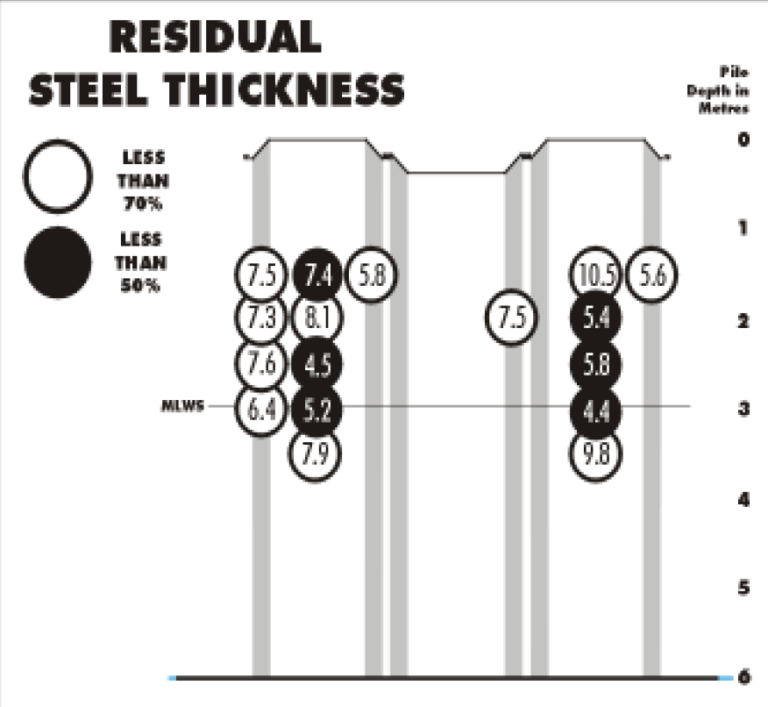
At Aberdeen Harbour surveys have shown (as
the chart on the right illustrates) that corrosion
of steel piles is taking place more quickly in some
areas than others. In recognition of this fact an
ongoing programme of survey has been
undertaken. This has already resulted in repair
works, including hydro-blasting, weld repairs
and application of a two-coat black/grey index
coded coating system where 15mm thick steel
sheet piles had become holed. With 5 km of
steel piled marine structures, Aberdeen is only
too aware of the potential threat to its
infrastructure. Its enlightened approach to
surveying and planned maintenance has recently
brought to light corrosion damage that, had not
repairs been undertaken, would almost certainly
have necessitated reconstruction of the berth
within 3 or 4 years – a far more costly and
disruptive alternative to its careful approach.
TESTING
The company’s positive experiences led, in 1998, to field tests in Northern Ireland on a site where
ALWC was causing extensive damage to the harbour at Killybegs. Blasting and coating to piles
underwater was undertaken, using divers to apply the coating. These areas remain in perfect condition.
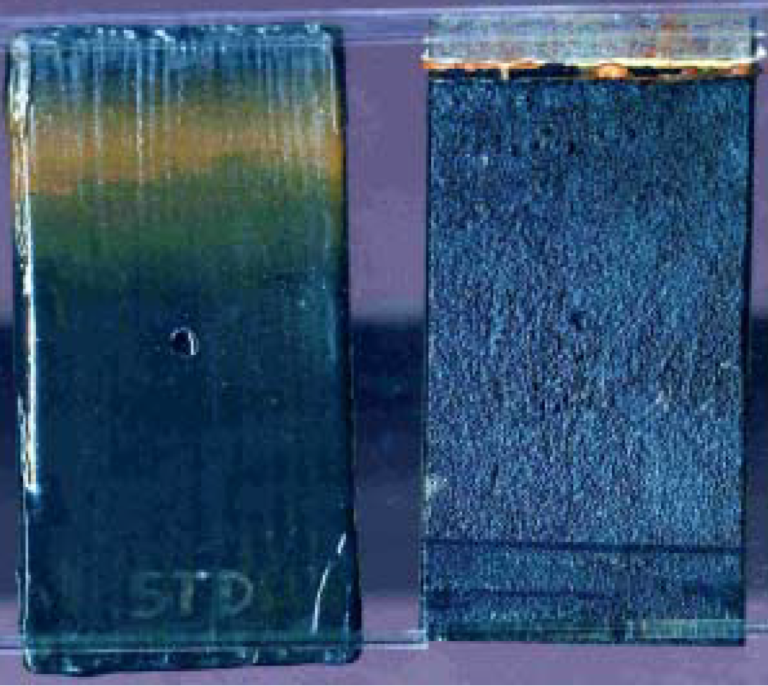
In order to provide laboratory backup for this successful record the company sought independent professional advice and agreed a MIC/Coating investigation test programme with Echa Microbiology Ltd based in Cardiff, S.Wales, UK.
In order to provide laboratory backup for this successful record the company sought independent professional advice and agreed a MIC/Coating investigation test programme with Echa Microbiology Ltd based in Cardiff, S.Wales, UK.
BASIC CONCLUSIONS
- That steel control panels representing areas of no coating presence are subject to severe corrosion/encrustation/Biofilm Generation.
- Whilst the Alocit Coatings are intact and not subject to corrosion breakdown, we know that any Biofilm presence is a function of surface deposition only. We have received no evidence that Alocit Coatings support the growth of MIC Biofilms.
BASIC CONCLUSIONS
To state that MIC/ALWC is a complex subject is a gross
understatement, it truly is difficult to accelerate the effects of
MIC/ALWC in the lab. Positive experiences in the field suggest
that excellent protection is possible, provided that good surface
adhesion can be achieved – not always easy when oil, salt
water and other contaminants are present, especially if the
structure must be coated underwater!
An obvious approach our company considered was the use of anti-foulants, microbiocides etc. However, if the potential effect of ‘leaching poisons’ has on the environment is considered, then our present approach of applying a uniform barrier coating, with the excellent underwater adhesion and inherently non-supportive of MIC/ALWC, is practically justified.
This paper features extracts and illustrations from the paper “inspections for Accelerated Corrosion on Marine Steel Piles” by J.B. Christie of Aberdeen Harbour Board, and is used in the context of promoting awareness of the problem.
An obvious approach our company considered was the use of anti-foulants, microbiocides etc. However, if the potential effect of ‘leaching poisons’ has on the environment is considered, then our present approach of applying a uniform barrier coating, with the excellent underwater adhesion and inherently non-supportive of MIC/ALWC, is practically justified.
This paper features extracts and illustrations from the paper “inspections for Accelerated Corrosion on Marine Steel Piles” by J.B. Christie of Aberdeen Harbour Board, and is used in the context of promoting awareness of the problem.
